Introduction
A lung cancer diagnosis can make everything feel urgent. Patients and families often want to know not only how the cancer can be treated, but also how they can get through treatment with less discomfort and return to everyday life sooner. If you are researching the Best Lung Cancer Specialist In Pune, one development worth understanding is the growing role of minimally invasive thoracic surgery. Modern techniques such as video-assisted thoracoscopic surgery, commonly called VATS, are changing how selected lung cancer operations are performed.
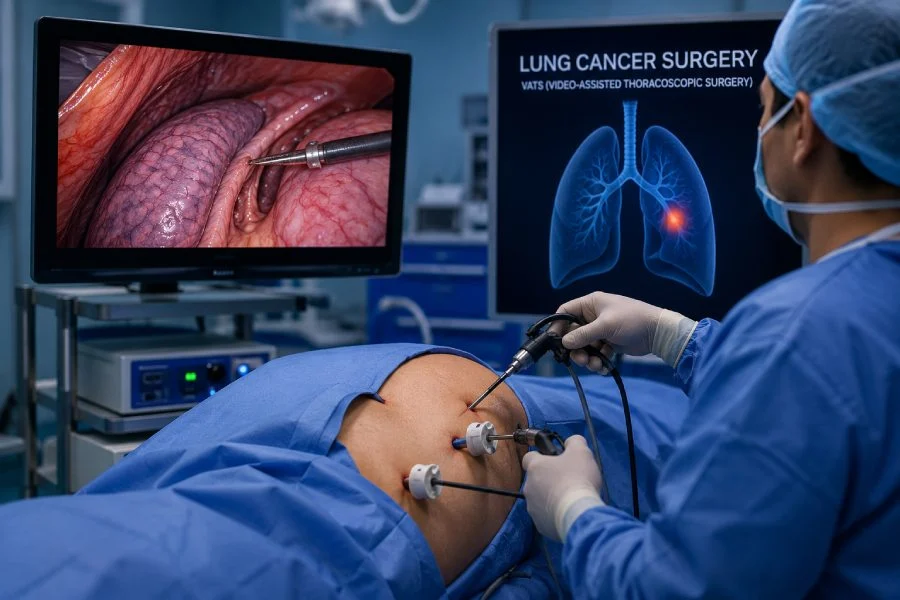
Instead of relying on a large chest incision, thoracoscopic surgery uses small openings through which a camera and specially designed instruments are introduced. The surgeon views the chest on a high-resolution monitor while removing the tumor or affected part of the lung when surgery is appropriate.
The important point is that minimally invasive surgery is not simply about making smaller cuts. Modern lung cancer surgery combines careful staging, anatomical planning, advanced imaging, lymph node assessment and surgical precision. The goal is to remove the cancer effectively while preserving as much healthy lung function as safely possible.
This article explains how thoracoscopic surgery works, where it fits into lung cancer treatment, what patients may experience during recovery and why the technique has become an important part of modern thoracic oncology.
What Is Modern Thoracoscopic Surgery?
Thoracoscopic surgery is a minimally invasive technique used to diagnose and treat conditions inside the chest. Video-assisted thoracic surgery, or VATS, uses a small camera called a thoracoscope along with specialized surgical instruments inserted through small incisions in the chest wall.
The camera transmits magnified images to a monitor, allowing the surgical team to see structures inside the chest without performing the larger incision traditionally associated with open thoracotomy.
For lung cancer, the approach may be used for procedures such as:
- Lung biopsy
- Wedge resection
- Segmentectomy
- Lobectomy
- Lymph node sampling or dissection
- Selected procedures involving the pleura or mediastinum
The exact operation depends on the cancer’s size, location, stage, relationship to blood vessels and airways, overall lung function and the patient’s general health.
According to the National Cancer Institute, surgical options for non-small cell lung cancer can include wedge resection, segmental resection, lobectomy, pneumonectomy and sleeve resection. The choice depends heavily on the individual clinical situation.
How Thoracoscopic Surgery Is Used in Lung Cancer Care
Surgery is not appropriate for every lung cancer patient. Before an operation is recommended, doctors need to understand what type of cancer is present and whether it has spread.
A typical assessment may include:
- CT imaging
- PET-CT when indicated
- Tissue biopsy
- Pulmonary function testing
- Blood investigations
- Cardiac assessment when required
- Lymph node evaluation
- Assessment of overall fitness for surgery
This information helps determine whether surgery is appropriate and, if so, how much lung tissue should be removed.
Wedge Resection
A wedge resection removes a small, wedge-shaped portion of lung containing the tumor along with an appropriate margin of surrounding tissue.
It may be considered in selected patients, particularly when preserving lung tissue is important or when the tumor characteristics make a limited resection appropriate.
Segmentectomy
A segmentectomy removes an anatomical segment of a lung lobe rather than the entire lobe.
This approach has become increasingly important for selected small, early-stage lung cancers. The decision is not simply based on tumor size. Tumor location, imaging characteristics, lymph node status, lung function and other factors all matter.
Lobectomy
A lobectomy involves removing the entire lobe containing the cancer.
For many patients with operable early-stage non-small cell lung cancer, lobectomy has historically been a standard surgical approach. Today, it can often be performed through VATS when the tumor and patient’s anatomy make a minimally invasive approach appropriate.
Lymph Node Assessment
Removing the visible tumor is only one part of lung cancer surgery.
Nearby lymph nodes may also be sampled or removed because they help determine whether cancer has spread beyond the primary tumor. Accurate staging can influence whether additional chemotherapy, immunotherapy, targeted therapy or radiation is recommended after surgery.
Why VATS Is Changing Lung Cancer Surgery
One of the biggest changes in modern thoracic surgery is the ability to perform complex procedures through relatively small access points.
With conventional open surgery, a thoracotomy involves a much larger incision and may require significant manipulation of the chest wall. VATS uses smaller incisions and a camera-based view of the operative field.
This difference can influence the patient’s postoperative experience.
Research published in The Lancet in March 2026 provided particularly important evidence. An individual patient data meta-analysis of three randomized trials involving 1,185 patients with early-stage non-small cell lung cancer found that VATS lobectomy was associated with better overall survival compared with open lobectomy, with a pooled hazard ratio of 0.79. Disease-free survival was similar between the approaches.
These findings are significant because earlier support for VATS was based largely on benefits such as reduced pain, shorter hospital stays and faster recovery. The newer analysis adds evidence about long-term survival.
However, this does not mean VATS is automatically the right choice for everyone. Technical feasibility and cancer characteristics remain central to surgical decision-making.
Major Benefits of Thoracoscopic Surgery
1. Smaller Incisions
One of the most visible advantages is the smaller size of the surgical access points.
Instead of the larger incision associated with open thoracic surgery, VATS generally uses several small incisions. The camera and instruments are introduced through these openings.
Smaller incisions can mean less disruption to the chest wall.
2. Less Postoperative Pain
Chest surgery can be uncomfortable because the ribs and surrounding tissues are involved.
Minimally invasive approaches generally cause less surgical trauma than open thoracotomy. This can reduce postoperative discomfort for many patients and make movement easier during recovery.
3. Faster Recovery
A major reason patients and surgeons consider VATS is the potential for a quicker recovery.
Mayo Clinic notes that VATS generally results in less pain, fewer complications and a shorter recovery compared with traditional open surgery.
The actual recovery period varies. Age, lung function, the type of operation, other medical conditions and postoperative complications can all influence recovery.
4. Shorter Hospital Stay
Many patients undergoing minimally invasive lung surgery can leave the hospital sooner than patients undergoing open surgery, provided their recovery is uncomplicated.
This can help patients return to their home environment and normal routines earlier.
5. Smaller Scars
Smaller incisions usually result in smaller scars. Although cosmetic appearance is not the primary goal of cancer surgery, it can still matter to patients.
6. Potentially Earlier Return to Daily Activities
Less postoperative discomfort and a shorter recovery can make it easier for patients to gradually resume walking, household activities, work and other normal routines.
The timing should always be individualized rather than based on a fixed number of days.
What Happens During VATS for Lung Cancer?
VATS is generally performed under general anesthesia.
After the patient is asleep, the surgical team creates small openings in the chest wall. A thoracoscope is inserted through one incision, while surgical instruments are introduced through other access points.
The surgeon views the inside of the chest on a monitor.
Depending on the operation, the surgical team may:
- Locate the tumor.
- Assess surrounding structures.
- Control and divide the relevant blood vessels and airway.
- Remove the planned portion of lung.
- Examine or remove regional lymph nodes.
- Check the surgical area for bleeding or air leakage.
- Remove the specimen for pathological examination.
- Close the small incisions.
The removed tissue is examined by a pathologist. The final pathology report provides important information about the tumor type, size, margins and lymph node involvement.
That report can influence what happens next.
The Role of Precision Technology in Thoracoscopic Surgery
Modern thoracic surgery is increasingly supported by technologies designed to improve visualization and anatomical precision.
One example is indocyanine green, commonly known as ICG.
ICG fluorescence can help surgeons identify tissue perfusion and anatomical boundaries during selected procedures. It may be particularly useful during anatomical segmentectomy, where distinguishing the segment being removed from the segment being preserved is important.
ICG can also assist with tumor localization in selected situations and may contribute to lymphatic mapping. The lung cancer treatment page for Dr. Kshitij Manerikar describes the use of ICG for perfusion assessment, segmental resection and tumor localization during thoracoscopic lung surgery.
Technology, however, should support surgical judgment rather than replace it. The usefulness of any technology depends on the patient’s anatomy, the tumor and the experience of the surgical team.
Is Thoracoscopic Surgery Suitable for Every Patient?
No.
This is one of the most important points for patients to understand. Although VATS has become an established approach for many lung operations, not every patient is a suitable candidate.
Factors that may influence the decision include:
- Tumor size
- Tumor location
- Involvement of major blood vessels
- Airway involvement
- Lymph node involvement
- Previous chest surgery
- Extensive scar tissue
- Lung function
- Overall health
- Bleeding risk
- Anatomical complexity
- Response to previous cancer treatment
Mayo Clinic also notes that previous chest surgery and certain health considerations can affect whether VATS is appropriate.
Sometimes a procedure planned as minimally invasive may need to be converted to open surgery if the surgeon encounters a situation where open access is safer or more appropriate.
That should not be viewed as a failure. The priority during cancer surgery is safe and complete treatment.
VATS vs Traditional Open Lung Surgery
| Feature | VATS | Open Thoracic Surgery |
|---|---|---|
| Incisions | Smaller incisions | Larger chest incision |
| Visualization | Camera and monitor | Direct surgical exposure |
| Chest wall trauma | Generally lower | Generally greater |
| Postoperative pain | Often less | Often more |
| Hospital stay | Often shorter | Often longer |
| Recovery | Often faster | Often slower |
| Suitable for all tumors | No | No |
| Cancer control | Depends on procedure and patient | Depends on procedure and patient |
| Surgical decision | Based on tumor and anatomy | Based on tumor and anatomy |
The choice should never be reduced to “keyhole surgery versus open surgery.”
A better question is: Which approach provides the safest and most effective cancer operation for this particular patient?
In selected early-stage cases where VATS is technically feasible, current evidence increasingly supports its use. The 2026 Lancet analysis strengthens the evidence base for VATS lobectomy in early-stage non-small cell lung cancer.
Recovery After Thoracoscopic Lung Surgery
Recovery does not end when the operation is over. Immediately after surgery, the medical team monitors breathing, oxygen levels, pain, drainage from the chest tube and other signs of recovery.
Patients are usually encouraged to begin moving as soon as it is safe. Walking helps reduce complications associated with prolonged bed rest. Breathing exercises can also be important after lung surgery. Depending on the patient’s condition, respiratory physiotherapy may be recommended.
During recovery, patients may experience:
- Fatigue
- Mild to moderate chest discomfort
- Temporary shortness of breath
- Reduced stamina
- Cough
- Changes around the incision sites
These symptoms generally improve over time, but the pace differs from person to person.
Follow-up appointments are important because the surgical team needs to review the pathology report, monitor healing and coordinate further cancer treatment when necessary.
Possible Risks and Limitations
Thoracoscopic surgery is minimally invasive, but it is still major surgery.
Potential complications can include:
- Bleeding
- Infection
- Air leakage
- Pneumonia
- Blood clots
- Irregular heart rhythm
- Breathing difficulties
- Prolonged chest tube drainage
- Reoperation in uncommon situations
- Conversion to open surgery
The risk depends on the patient’s health, the complexity of the procedure and the extent of the cancer.
Another limitation is that minimally invasive surgery requires specialized equipment, appropriate patient selection and a surgical team with relevant expertise.
A smaller incision does not automatically mean a simpler operation.
How Surgery Fits Into Modern Lung Cancer Treatment
Lung cancer treatment has become increasingly personalized.
Surgery may be one component of a broader treatment plan involving:
- Chemotherapy
- Immunotherapy
- Targeted therapy
- Radiation therapy
- Molecular testing
- Active surveillance in selected circumstances
- Supportive and rehabilitative care
For some patients, systemic treatment may be recommended before surgery. This is sometimes called neoadjuvant therapy.
For others, additional treatment may be considered after surgery based on the final stage and pathological findings.
This is why lung cancer care should not be viewed as a single operation.
The surgical approach, timing of surgery and extent of resection should be considered alongside pathology, imaging and the patient’s overall treatment plan.
Pros and Cons at a Glance
Pros
- Smaller incisions
- Often less postoperative pain
- Potentially shorter hospital stay
- Faster recovery for many patients
- Smaller scars
- Earlier mobility
- High-definition visualization
- Can support precise anatomical lung resections
- Increasing evidence supporting its use in selected early-stage lung cancer
Cons
- Not appropriate for every tumor
- Requires specialized expertise and equipment
- Previous chest surgery may complicate the procedure
- Complex tumors may still require open surgery
- Complications can still occur
- Some procedures may need conversion to open surgery
- Recovery still requires adequate rest and follow-up
The right surgical method is therefore determined by the cancer, not by the popularity of a particular technique.
Conclusion
Modern thoracoscopic surgery has changed the way many lung cancer operations are approached. By combining small incisions with high-quality visualization, specialized instruments and increasingly precise imaging technologies, VATS can reduce the physical impact of surgery while allowing surgeons to perform complex procedures in appropriately selected patients.
For patients facing a lung cancer diagnosis, the most useful conversation is not simply about whether surgery can be done through small incisions. It is about whether surgery is appropriate, how much lung should be removed, how the cancer will be staged and how surgery fits into the complete treatment plan.
FAQ’s
Thoracoscopic surgery for lung cancer is a minimally invasive technique in which a camera and specialized instruments are inserted through small chest incisions. It can be used for procedures such as biopsy, wedge resection, segmentectomy and lobectomy in appropriately selected patients.
The benefits of thoracoscopic surgery can include smaller incisions, less postoperative pain, shorter hospital stays, faster recovery and smaller scars compared with traditional open surgery. Individual results vary based on the patient’s health and the complexity of the operation.
Depending on the patient’s condition, VATS can be used for wedge resection, segmentectomy, lobectomy and selected lymph node procedures. The exact operation depends on tumor size, location, stage, lung function and other clinical factors.
Take the next step toward a more informed lung cancer treatment plan.
Recent Posts
- What Makes Head and Neck Cancer Different From Other Cancers?
- Can Cancer Surgery Be Minimally Invasive? Here’s What to Know
- When Should You See a Gynaecological Cancer Specialist?
- How Surgical Oncologists Help Patients Make Better Cancer Treatment Decisions
- How Is Oral Cancer Diagnosed? A Step-by-Step Look at the Process